
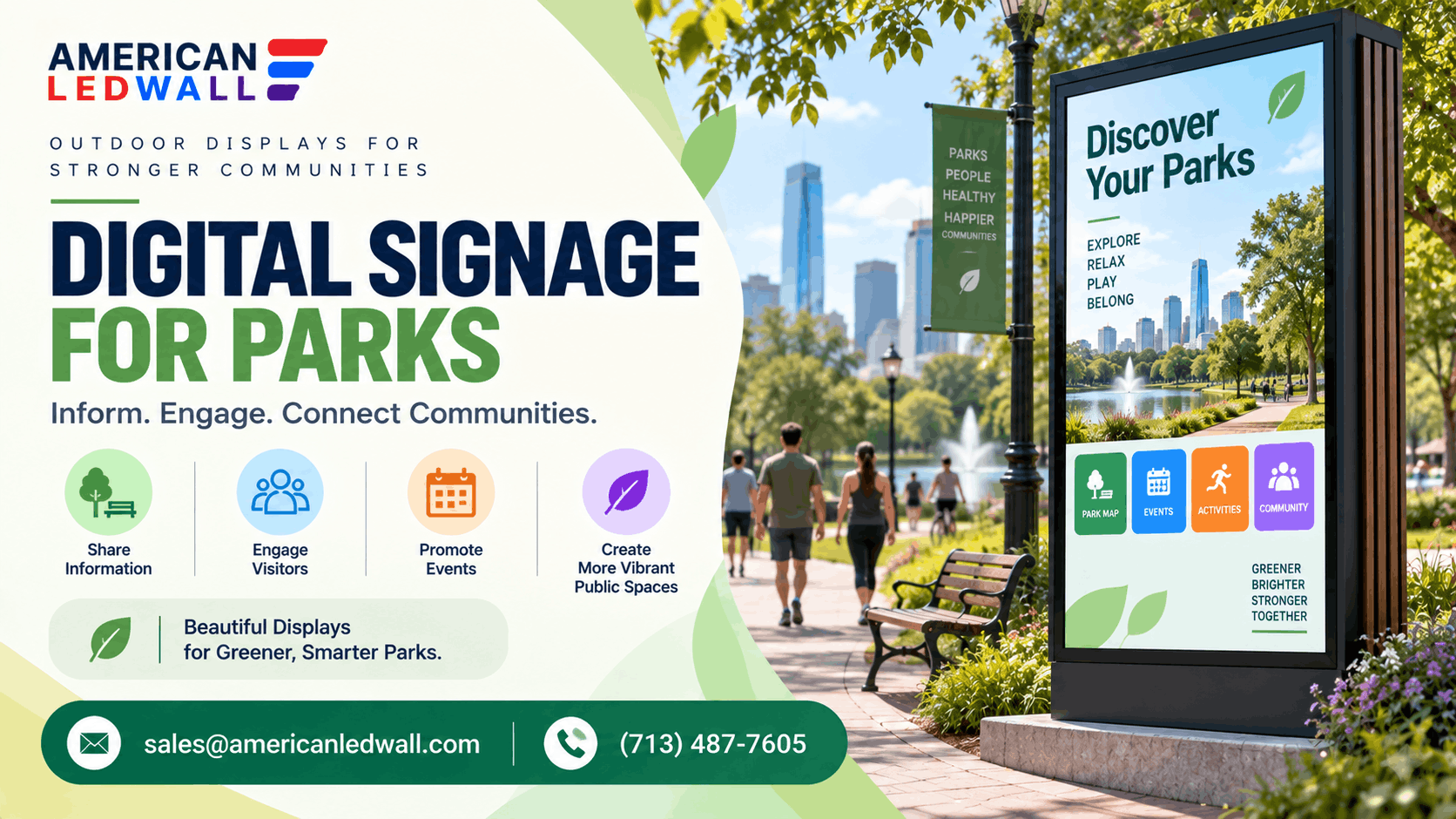
A parks and recreation team has a different problem than a theme park. The screens you put in a public park have to survive with nobody watching them, run in spots where there is no power outlet nearby, and get funded through a budget or a grant instead of ticket sales. That changes what you buy and how you plan it.
Digital signage for parks is the set of outdoor screens a public park uses to post hours, maps, program schedules, event notices, and safety alerts. It is one slice of digital signage for parks and recreation, and this guide is written for city, county, and state parks, recreation departments, botanical gardens, and trail systems, not amusement parks. If you run a ride-based venue, our amusement park displays guide covers that setting separately.
This guide covers where those screens are worth the money, how bright and rugged they have to be, how to power one where there is no grid, what a realistic build costs, and how to pay for it. The parts that matter are the ones the marketing pages skip.
Where a Public Park Puts Screens
Screens do not belong everywhere in a park. They pay off in a few specific spots.
| Location | What it shows | Typical display |
| Entrance or roadside | Hours, closures, events, welcome | Full-color LED board or display |
| Trailhead or wayfinding | Map, trail, and weather conditions, distance | Weatherproof LCD, e-paper, or LED |
| Sports complex | Field schedules, scores, and rain delays | Outdoor LED display or scoreboard |
| Recreation center | Class schedules, registration, notices | Indoor or covered LED or LCD |
| Parking and pavilions | Wayfinding, availability, rules | LED or weatherproof LCD |
| Paths and gathering areas | Nature education, donor recognition | LCD or LED |
At the entrance, an LED message board for parks does the most visible work. It posts hours, closures, and the weekend event, and you update it from a laptop instead of a ladder. A larger roadside LED display makes sense where drivers read the sign from the road.
Park wayfinding signage at trailheads and junctions replaces the faded map board, and it can show live trail or weather conditions that a printed map never will. Inside, the recreation center’s digital signage carries class schedules, registration deadlines, and community notices that used to live on a corkboard. Out at the fields, a bigger outdoor LED sign for parks handles schedules, scores, and rain-delay calls that spectators need at a glance.
How a City Parks Department Actually Uses One
Most cities already run one of these, even if you have not noticed it. Drive past a community park or a recreation center, and you will often see a color LED board at the entrance showing the pool hours, the youth soccer signups, and a line about the road closure for the Saturday 5K.
The parks department controls it from the office. When a storm rolls in, one message goes out across every board: fields closed, come back tomorrow. When registration opens, the board becomes the reminder nobody can miss on the way in. The sign belongs to the department and sits on land the department controls, so the content is theirs to change any time, with no print shop and no ladder.
State and national parks lean on the same idea on a bigger scale. Digital signs at park roads and trailheads post fire danger, trail closures, and weather, where a paper notice would blow away or go stale. This is a world apart from a theme park, where screens manage ride queues and crowds, which our theme park screen guide covers. In a public park, a screen is worth it when the message changes often and matters right now.
Powering a Sign When There Is No Outlet Nearby
The hardest part of a park install is often not the screen. It is getting power and a signal to a spot in the middle of a field.
Three options cover most sites. Where grid power is close, you trench conduit to the location, which is the simplest choice and usually the cheapest to run over the years. Where the grid is far, trenching gets expensive fast, and solar with a battery starts to make sense. Where a spot is truly remote, like a backcountry trailhead, a low-power e-paper panel or a small monochrome board can run on a modest solar setup for years.
Match the power source to the screen, not the screen to the power source. A large full-color LED wall in full sun draws a lot of current, which is hard to cover with solar alone, so those belong on grid power. Message boards and e-paper draw far less, so they are the ones that run well off a panel and a battery. For the signal, where there is no fiber, a cellular modem lets you push updates to the sign over the same network your phone uses.
Building for an Unsupervised Outdoor Site
A park screen sits outside with nobody guarding it, so it has to handle weather and the occasional troublemaker on its own.
Start with the seal. An outdoor-rated display is built to an IP65 or IP66 rating on the front and back, which keeps out rain and dust, and it runs across a wide range, roughly minus 4 degrees F to 122 degrees F. Add surge and lightning protection, because an open field is exactly where a strike finds a path. If the spot floods, mount the screen and its power box above the high-water line. A polycarbonate shield over the face, tamper-proof fasteners, and a solid mount or bollards handle the vandalism most parks see. Our outdoor-rated LED panels are sealed and built for open-air spots like these.
One thing parks get wrong is brightness at night. A screen that is comfortable at noon can be blinding after dark and can disturb wildlife, and many towns have dark-sky rules near parks and preserves. Use an ambient light sensor so the display dims on its own, and schedule it to drop low or shut off during quiet hours.
Picking the Right Display for Each Spot
Once you know the spot, two specs decide the screen: how bright it needs to be, and how close people stand.
| Placement | Typical brightness |
| Indoor or covered (rec center lobby, pavilion) | 700 to 1,500 nits |
| Partial sun (shaded entrance, trailhead) | 2,500 to 4,000 nits |
| Full sun (open entrance, roadside, sports field) | 5,000 to 8,000 nits |
Pixel pitch sets how close a person can stand before the image breaks into dots. A rough rule: the closest comfortable distance in feet is about three times the pitch in millimeters. A rec-center screen people read from a few feet away wants a fine 1.9 to 2.6 mm pitch, while a roadside park sign read from a passing car can use a wider pitch, which also keeps the price down.
Three display types cover parks. A full-color LED display or message board is the default for entrances, sports, and anything read at a distance. A weatherproof LCD suits a covered wayfinding kiosk, read up close. E-paper, the technology in an e-reader, uses almost no power and stays readable in direct sunlight, which makes it the quiet choice for a solar trailhead sign that shows a map and a few lines of text. If you are weighing the panel technology, how direct view works explains why direct-view LED holds up outdoors at larger sizes.
Outdoor Panels That Fit a Park
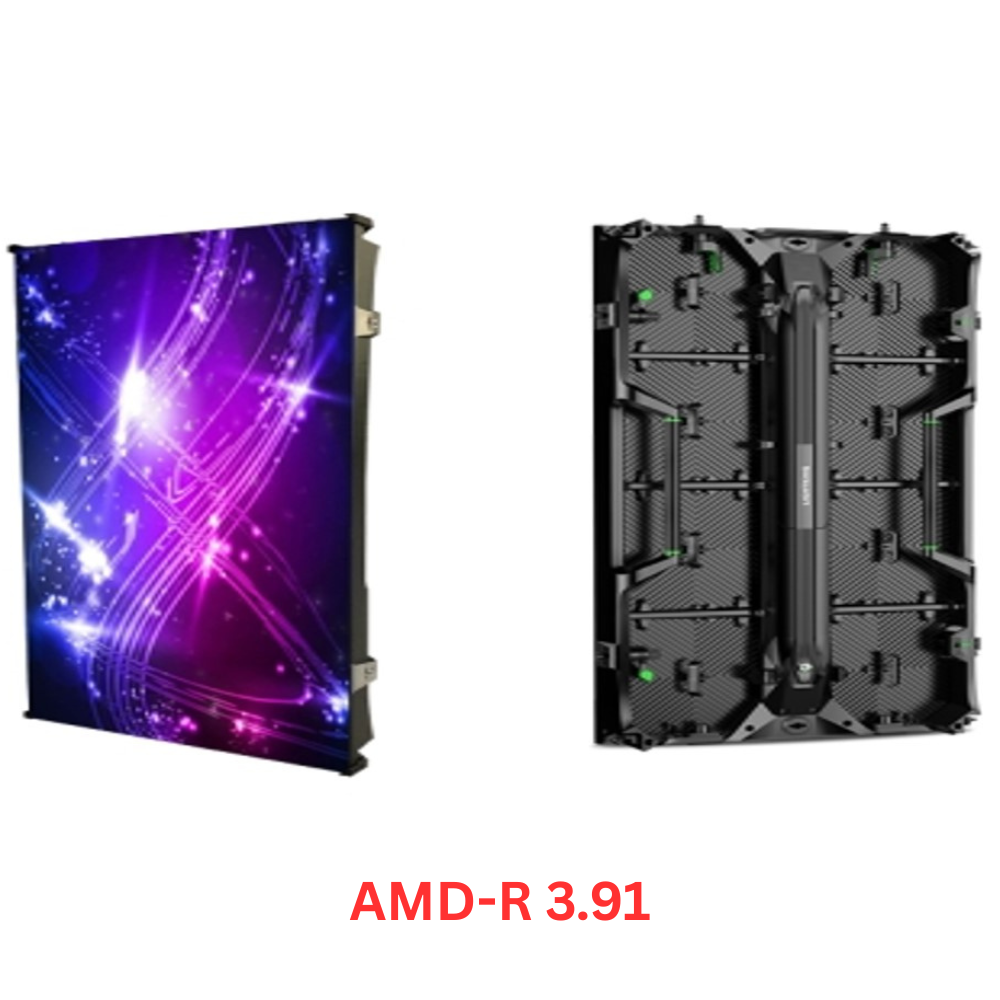
For a starting point, here are three outdoor panels from our lineup, sized for a roadside sign, a wayfinding screen, and a rec-center display.


What Digital Signage for Parks Costs, and How to Fund It
In short, a monochrome entrance board runs in the low five figures, a full-color LED display is priced by the square foot, and power, structure, and software add to either. Here is a working range to plan around; confirm current pricing for your build. Our outdoor screens cost guide breaks the per-square-foot math down further.
| Display type | Typical installed cost |
| Monochrome LED message board (entrance hours and alerts) | 3,000 to 15,000 US dollars |
| Full-color outdoor LED display (per square foot) | 1,200 to 3,000 plus US dollars per sq ft |
| Weatherproof LCD kiosk (wayfinding) | 4,000 to 12,000 US dollars per unit |
| Solar and battery add-on (off-grid site) | 3,000 to 10,000 US dollars |
The screen is one line on the invoice. Budget also for the foundation or mount, trenching or solar, a cellular plan, content software, and yearly maintenance. A single entrance board is a low five-figure project, while wiring an entire park system runs well into six figures and is best phased over a few seasons.
Paying for it is where parks have more room than they think. Many boards come out of a capital budget rather than the yearly operating line. Grants help too: the federal Land and Water Conservation Fund, state recreation and tourism grants, and local park bonds all fund park improvements, and a safety and communication screen fits several of them. Sponsorship works where your policy allows it, with a local business credited on the board.
You may not need a formal bid. Cooperative purchasing programs such as Sourcewell, OMNIA Partners, and BuyBoard let a public agency buy off an existing contract, which skips a full RFP and shortens the timeline. This is how most municipal digital signage gets bought without a year of paperwork, and it is also the part that speaks to a council. An entrance board that cuts calls to the parks office, reaches everyone during a closure, and carries sponsor credit is easy to defend at budget time.
Turning Screens Into an Emergency Tool
A park sign does a second job the day something goes wrong. The same board that shows soccer signups can switch to a flood warning, a wildfire evacuation route, or a missing-child alert, and reach every visitor in the park at once.
The strongest setups tie the screens into the alerting system the city already runs, so a single message reaches signs, phones, and sirens together. Displays that can pull from a standard alert feed will show a severe-weather or evacuation notice on their own, without someone typing it during the emergency. The screen is the hardware here; the alert feed comes from the alerting platform, so plan that integration when you buy. If your parks fall under a wider public-safety plan, our government display systems page covers the control-room side of that.
Frequently Asked Questions
How much does an outdoor park LED sign cost?
A monochrome LED message board for a park entrance usually runs 3,000 to 15,000 US dollars, depending on size, while a full-color outdoor LED display runs about 1,200 to 3,000 US dollars or more per square foot installed. Add the mount, power or solar, a cellular plan, and content software. A single board is a low five-figure project, and a park-wide system runs into six figures.
Are LED signs allowed in public parks?
Usually, yes, for the informational signage a park runs for itself, but it is subject to local rules. Many towns cap brightness, limit animation, and set quiet hours, and areas near nature preserves often have dark-sky ordinances. Check your municipal sign code, and for a state or national park, the policy the agency sets, before you spec the screen.
How bright should an outdoor park LED sign be?
For full sun at an entrance or roadside, aim for 5,000 to 8,000 nits. A shaded entrance or trailhead needs about 2,500 to 4,000 nits, and an indoor or covered screen needs 700 to 1,500. Use an automatic brightness sensor so the sign dims at night and stays readable at noon.
Can park signage show community events and alerts?
Yes, that is the main reason parks use it. One screen can rotate hours, program registration, event notices, and sponsor messages, then switch to a weather, closure, or evacuation alert the moment it is needed, updated remotely from the parks office.
How do you power outdoor digital signage in a park?
Three ways. Trench grid power to the spot where the grid is close, use solar with a battery where it is far, and use a low-power e-paper or monochrome board on a small solar setup at remote trailheads. Large full-color LED displays draw too much power for solar alone, so those need grid power.
Get a Plan for Your Park
The parks that do this well start with one screen at the spot that needs it most, prove it over a season, and grow from there. Match the display to the light and the viewing distance, build it to survive the weather and the after-hours crowd, and pick a power source that fits the location.
When you are ready to plan digital signage for parks for your entrance, your trails, or a whole park system, send American LED Wall your park map and the spots you want to cover, and the team will spec the brightness, pitch, and size for each one with a real budget. If you want a rough number first, our screen size calculator sizes a display in about a minute.
